Manual handling is a clinical safety protocol, not just a physical task. Choosing the right assistance tier is the only way to ensure long-term dignity and safety at home. WorkSafe Victoria identifies hazardous manual handling as a primary cause of physical harm in the healthcare sector. You likely feel the weight of this responsibility every day. Finding reliable manual handling personal care support is about more than just getting help. It's about establishing a framework that protects both the client and the caregiver from preventable injury.
We understand that the transition to using mobility equipment can feel overwhelming. You need to know exactly what is required to maintain a safe home environment without unnecessary complexity. This guide provides a pragmatic look at safety protocols, equipment options, and the specific support levels available to Melbourne families. We will outline the practical steps to assess your needs, the function of various lifting aids, and how to determine if a situation requires a one-assist or two-assist approach.
Key Takeaways
- Define the scope of manual handling personal care support as a clinical safety protocol designed to prevent injury for both clients and carers.
- Learn to distinguish between a One Assist Visit and a Two Assist Visit based on a client's mobility, weight-bearing ability, and cognitive state.
- Understand how the correct equipment reduces physical force to near zero, ensuring safe transfers and reducing carer strain.
- Identify why a formal risk assessment is mandatory in Melbourne homes to manage environmental hazards like tight corners or uneven flooring.
- Establish a framework for providing dignified hygiene and mobility assistance that prioritizes long-term safety and stability.
What is Manual Handling in Personal Care?
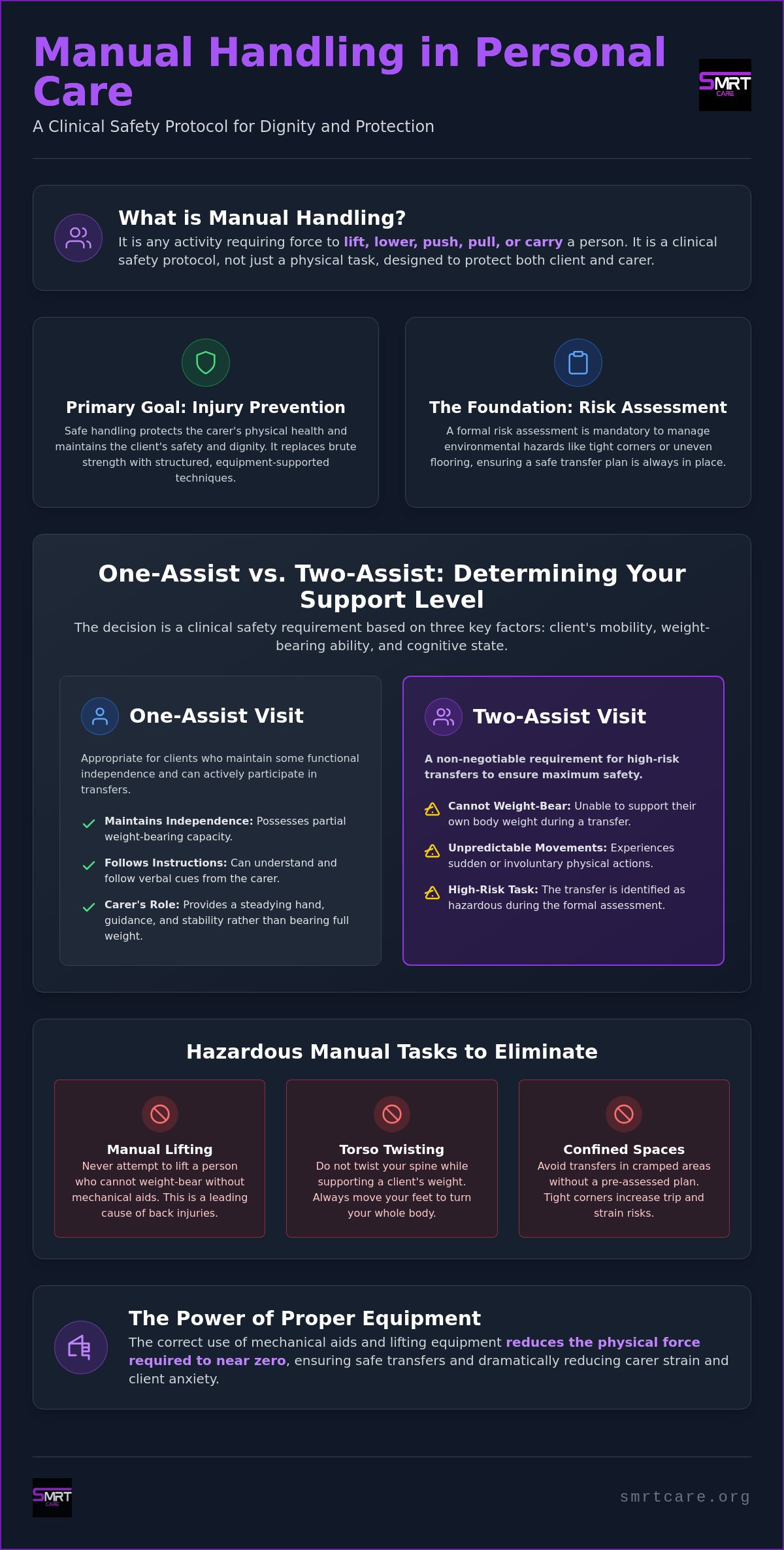
Manual handling in a personal care context is any activity requiring the use of force to lift, lower, push, pull, or carry a person. It is a clinical safety protocol, not just a physical task. The primary goal is to maintain client safety while protecting the carer's physical health. Professional manual handling personal care support replaces traditional "lifting" with structured, equipment-supported techniques. This approach ensures that physical assistance is predictable and controlled. It moves away from brute strength and focuses on mechanical advantage and ergonomic principles.
Common tasks that require these protocols include:
- Bed-to-chair transfers for individuals with limited mobility.
- Showering assistance involving wet surfaces and limited space.
- Repositioning in bed to maintain skin integrity and comfort.
- Assisting with standing or seated transitions.
To establish a baseline for safety, it's helpful to understand What is manual handling in a broader sense. In the home care sector, the "load" is a human being with unique physical and cognitive needs. This adds a layer of complexity that requires specific training and equipment to manage effectively. Without these tools, the risk of injury increases significantly for everyone involved.
Why Safe Manual Handling Matters
Safe manual handling is non-negotiable for long-term home care. It prevents musculoskeletal injuries for both the client and the support worker. In Victoria, the healthcare and social assistance sector historically reports high injury rates due to poor manual handling. Using the correct manual handling personal care support techniques ensures the dignity of the individual during intimate tasks. It transforms a potentially stressful transfer into a secure, routine procedure. These practices also ensure compliance with Australian WHS standards for home-based care environments, which require risks to be minimized through proper planning.
Hazardous Manual Tasks to Avoid
Identifying hazards is the first step toward a safe home environment. Certain actions are high-risk and should be eliminated through better planning or equipment use. Avoid these common mistakes:
- Manual lifting: Never attempt to lift a person who cannot weight-bear without mechanical aids. This is the leading cause of back injuries.
- Torso twisting: Do not twist your spine while supporting a client's weight. You must move your feet to turn your whole body.
- Confined spaces: Don't work in cramped areas like small Melbourne bathrooms without a pre-assessed transfer plan. Tight corners increase trip risks.
A safe environment requires clear boundaries and the right tools. If a task feels unsafe, it usually is. Structured protocols remove the guesswork from daily care routines and prioritize the long-term health of the carer.
One-Assist vs. Two-Assist: Determining Your Support Level
Determining the required number of carers is a critical safety decision. It's not about convenience; it's about risk mitigation. Support levels are dictated by three primary factors: the client's physical mobility, their ability to bear weight, and their cognitive state. A client who can follow instructions but lacks balance has different needs than a client who cannot support their own weight or who experiences sudden, unpredictable movements. Selecting the wrong tier increases the risk of falls and long-term physical strain on the support worker.
Professional assessments are the foundation of safe home care. These evaluations ensure that the manual handling personal care support provided aligns with the physical realities of the client. Following WorkSafe Victoria's handling guide is the standard practice for identifying and controlling these risks in Melbourne. If a task is identified as high-risk during the initial assessment, a two-person team becomes a non-negotiable requirement. This approach maintains a safe working environment and ensures the dignity of the person receiving care.
When One-Assist is Sufficient
A One Assist Visit is appropriate for clients who maintain some functional independence. These individuals can typically follow verbal instructions and possess partial weight-bearing capacity. Common scenarios include providing a steadying hand while the client uses a walking frame or assisting with grooming and dressing. In these cases, the carer offers guidance and stability rather than taking the full weight of the individual. This level of support focuses on maintaining current mobility levels while ensuring the client doesn't lose their balance during daily transitions.
When Two-Assist is Essential
High-dependency situations require a Two Assist Visit. This staffing level is mandatory for non-weight-bearing clients who require full mechanical hoisting for transfers between beds, chairs, or commodes. It's also essential for bariatric care where the physical load exceeds safe limits for a single individual. Beyond weight factors, two carers are necessary for clients with cognitive impairments that lead to unpredictable movements. During hygiene tasks in wet areas, a second pair of hands provides the necessary redundancy to prevent falls. If you're unsure which tier fits your situation, viewing our specific One Assist and Two Assist options can help clarify the requirements for your home environment.
Safe physical assistance requires a realistic look at a client's daily needs. We don't guess when it comes to physical safety. Every transfer must be performed with the correct number of trained staff to ensure the process is controlled, predictable, and respectful of the individual's comfort.
Essential Manual Handling Equipment for the Home
The right equipment is the foundation of safe manual handling personal care support. It reduces the physical force required from a carer to near zero. This shift from manual lifting to mechanical assistance is what prevents long-term musculoskeletal injuries. Equipment selection isn't a generic process. It depends on the client's specific mobility goals and the physical layout of the Melbourne home. A device that works in a spacious facility might not fit in a standard residential bathroom or bedroom. Every piece of machinery must be fit for purpose and compatible with the environment.
Ownership of equipment comes with significant responsibility. Maintenance and sling inspections are critical safety requirements. Slings should be checked before every use for signs of fraying, loose stitching, or compromised loops. Even a minor tear can lead to a catastrophic failure during a transfer. Additionally, carers must be trained on the specific model of equipment present in the home. Operating a Birdie Evo Compact Hoist is different from using a Jasmine Patient Lifter. We don't assume that knowledge of one brand translates to another. Familiarity with the specific controls and emergency stop functions is mandatory for every visit.
Active Transfer Aids
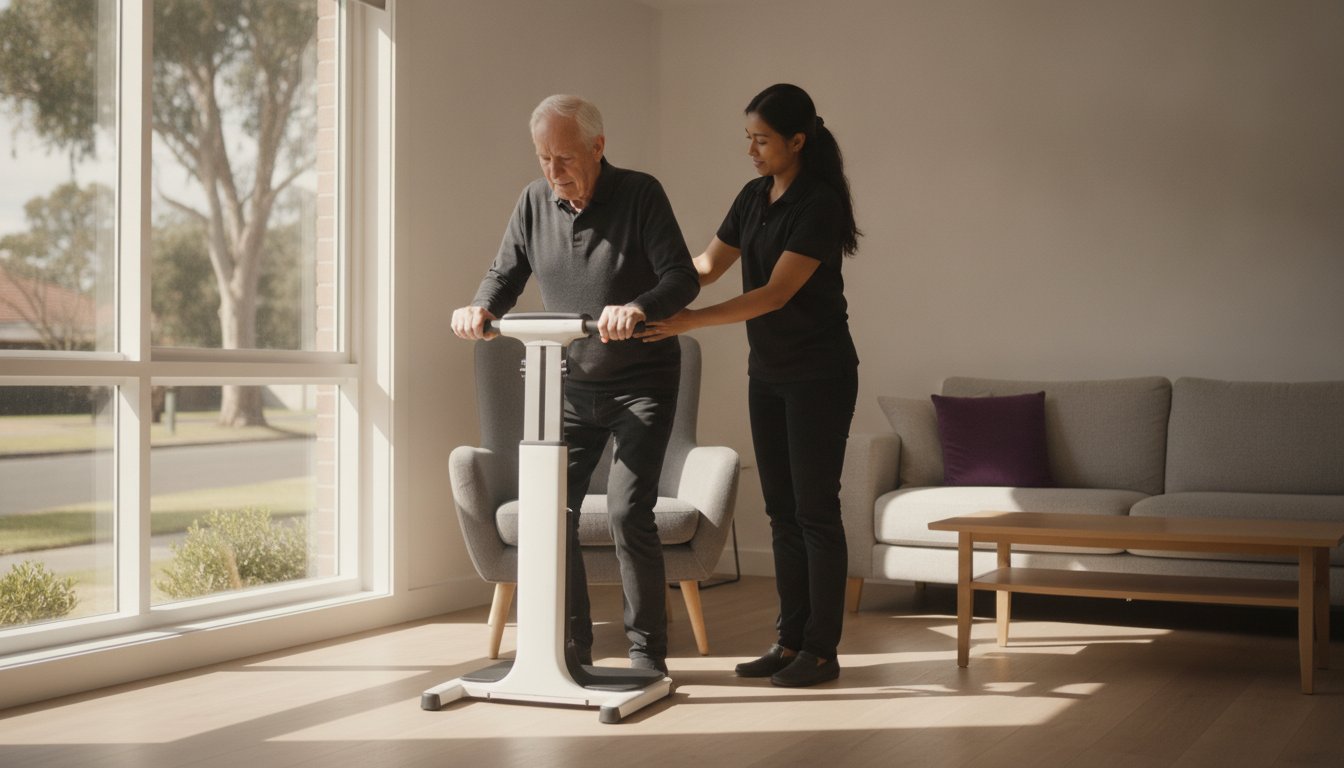
Active transfer aids are designed for clients who can sit and pull themselves to a standing position. These devices are ideal for quick, dignified transfers from a bed to a shower chair or commode. They encourage the client to use their remaining strength, which helps maintain functional mobility. However, these aids require the client to have sufficient core strength and the ability to maintain a firm grip on the handles. If a client's strength fluctuates throughout the day, an active aid may only be appropriate during their strongest periods.
Passive Hoists and Slings
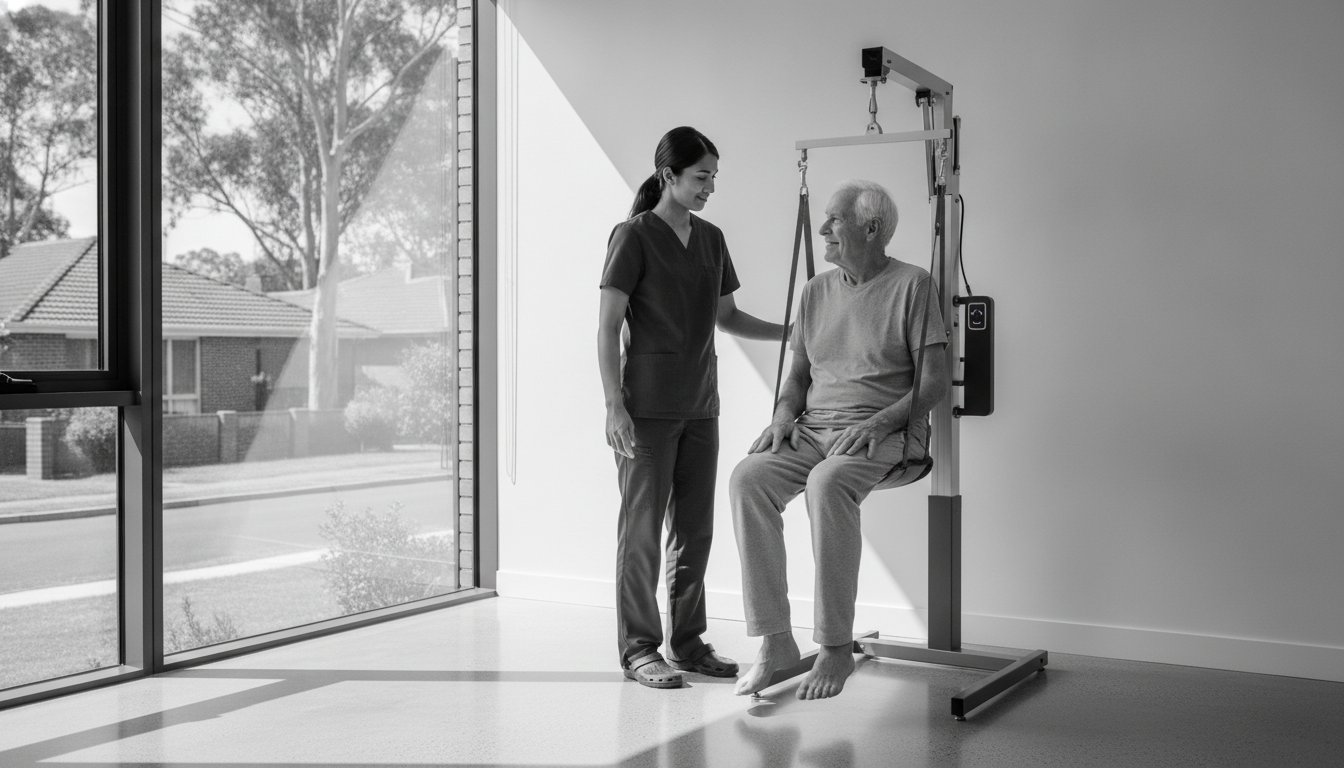
Passive hoists are used for clients who cannot assist with the transfer at all. These full-body lifters take the entire weight of the individual. Choosing the correct sling size and type is essential for protecting skin integrity and ensuring stability. A sling that is too small can cause skin shearing, while one that is too large risks the client slipping out. These hoists are primarily used for bed-to-chair transfers or in emergency floor-to-bed situations. In Melbourne, compact mobile hoists often start around A$2,790, making them a significant but necessary investment for high-dependency care.
In-Bed Mobility Tools
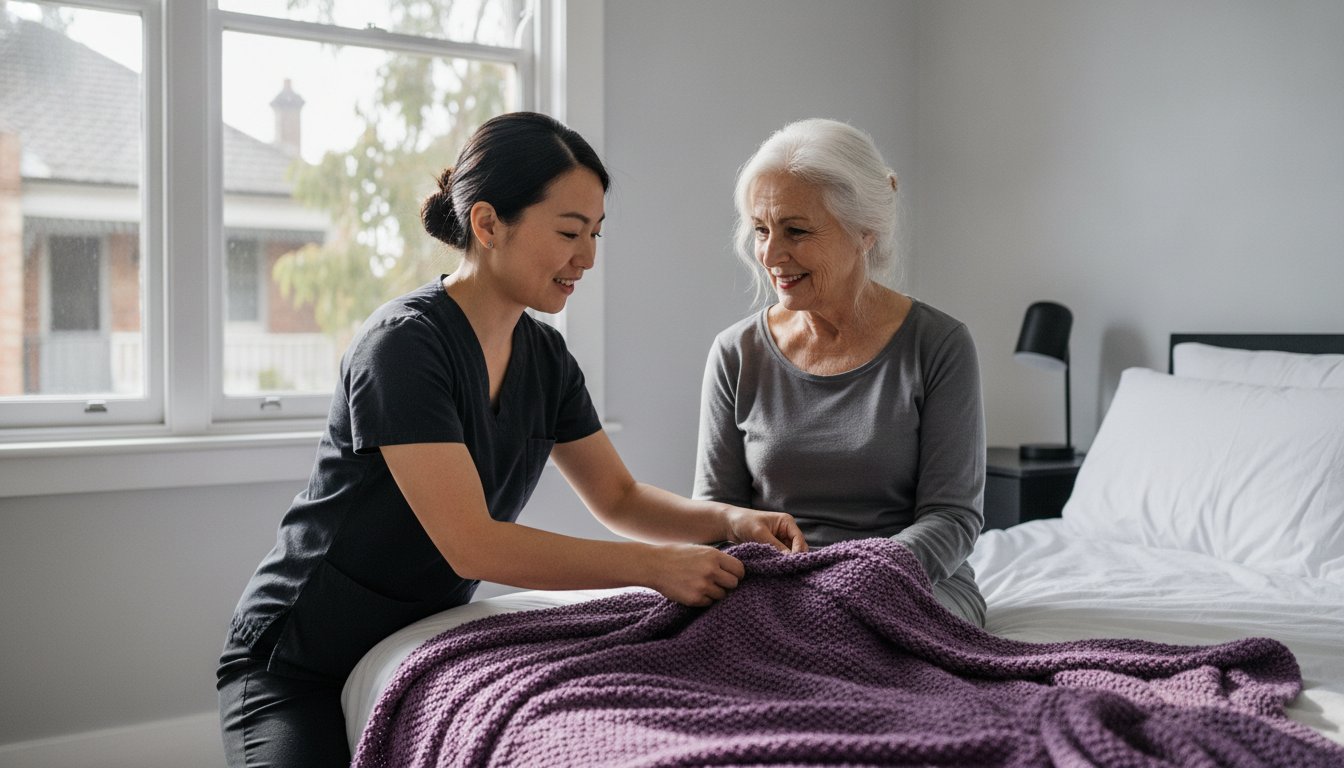
Repositioning a client in bed is a high-frequency task that carries a high risk of back strain. Electric hospital beds are foundational because they allow for height adjustment, letting the carer work at a safe waist height. Slide sheets are utilized to glide a client across a bed surface, reducing friction to protect skin integrity during pressure area care. Using these tools correctly ensures that the client remains comfortable while the carer's spine is protected from the repetitive strain of manual boosting or turning.
Safety Protocols and Risk Management in Melbourne Homes
Home environments often present more hazards than clinical facilities. Hospitals are designed with wide corridors and non-slip flooring. Melbourne homes frequently feature thick rugs, tight corners, and varied floor levels. These physical realities increase the risk of trips and equipment failure during daily routines. A formal risk assessment must be completed before the first care visit. This assessment documents the specific layout and identifies where manual handling personal care support might be obstructed. It's a foundational step for long-term safety and operational reliability.
Clear communication between the carer and the client is the foundation of a safe transfer. Transfers are high-risk moments that require total focus. Both parties must understand the sequence of movement before it begins. Carers are trained to "stop and reassess" if a client becomes distressed, resistive, or unstable. We don't force a transfer under unsafe conditions. If the physical or cognitive state of the client changes, the protocol changes immediately. This disciplined approach ensures that safety always takes precedence over the schedule.
Preparing the Space for Safe Care
A safe environment requires active preparation. You must remove trip hazards like loose mats and electrical cords from the transfer path. These items are the primary cause of carer falls during weight-bearing tasks. Ensure adequate lighting in bathrooms and bedrooms to eliminate shadows that hide obstacles. Finally, maintain enough clearance around the bed for hoist maneuverability. A hoist requires a specific turning circle to operate safely. If the room is too cluttered, the equipment cannot function as intended.
The 5-Step Safe Transfer Process
Professional transfers follow a methodical, five-step sequence to reduce the chance of human error.
- Assess: Check the client's current physical state and the environment for new hazards.
- Prepare: Gather all necessary equipment and position the chair or bed correctly.
- Communicate: Tell the client exactly what is about to happen before you move them.
- Execute: Perform the transfer using approved biomechanical techniques and equipment.
- Check: Ensure the client is comfortable, stable, and correctly positioned in their new seat or bed.
Maintaining these protocols requires a reliable partner. You can book a professional care visit to ensure your home environment meets these essential safety standards.
Consistency is the key to effective risk management. When every carer follows the same 5-step process, the client feels more secure. This predictability reduces anxiety during intimate care tasks. It also ensures that high standards of manual handling personal care support are maintained regardless of which staff member is on duty. Safety is a shared responsibility that begins with a clear, documented plan.
SMRT Care: Pragmatic Manual Handling Support
SMRT Care operates with a focus on absolute transparency. We provide fixed-price packages for families needing reliable manual handling personal care support. Our model removes the uncertainty of fluctuating costs and complex contracts. We prioritize fundamental care needs: hygiene, mobility, and safety. Each visit is structured around a specific set of tasks to ensure a predictable and high-quality outcome. We deploy trained personal care attendants who understand the physical and logistical requirements of home-based assistance. There are no hidden fees or administrative surprises. You receive professional support exactly when you need it.
Our approach is grounded in the reality of daily life. We recognize that personal support is a necessity, not a luxury. By maintaining strict professional boundaries and clear service definitions, we provide a service that is both helpful and sustainable. We focus on the core requirements of safety and dignity for every client we serve in the Melbourne area. This disciplined methodology ensures that every transfer and hygiene task is performed with clinical precision.
Our Tiered Support Packages
- Basic Care Visit: This tier provides essential support for bedridden clients. It includes an In-bed Wash to maintain hygiene when transfers are not possible or appropriate.
- One Assist Visit: This is practical help for individuals who require a single carer for routine tasks. It is designed for those who can partially assist or maintain balance during transfers.
- Two Assist Visit: This package ensures safe, equipment-backed support for high-dependency mobility. It is mandatory for tasks involving full mechanical hoisting or bariatric requirements.
- Showering Assistance: A targeted service focused on maintaining safety in wet areas, utilizing appropriate manual handling techniques and equipment.
Booking Support in Melbourne
The onboarding process for families is straightforward. We avoid bureaucratic delays to ensure that care can begin quickly. Our focus remains on establishing a routine that prioritizes the client's dignity. This is particularly important for individuals living with neurological or age-related conditions where consistency is vital. We work within the parameters of your home environment to implement the safety protocols discussed in this guide. Reliable assistance starts with a clear understanding of your specific needs and a commitment to professional excellence. You can View our fixed-price care packages and book a visit to begin the process.
Stability and safety are our primary objectives. We provide the framework for a secure home environment through disciplined service delivery. By choosing a partner that values integrity and efficiency, you ensure that your loved one receives the highest standard of physical assistance. We are here to provide the essential support that makes daily living safer for everyone involved.
Establishing a Safe Care Routine at Home
Establishing a safe home environment requires a disciplined approach to physical assistance. You now understand the distinction between one-assist and two-assist tiers and the critical role of mechanical aids. Implementing these protocols protects the physical health of both the client and the carer. Safe manual handling personal care support is a fundamental necessity that ensures long-term stability. By prioritizing risk assessment and the correct equipment, you maintain the dignity of your loved one while minimizing hazardous physical strain. Consistent routines reduce anxiety and create a predictable environment for daily living.
SMRT Care is a Melbourne-based local provider focused on transparent, reliable support. We specialize in 1-assist and 2-assist care delivered through straightforward, fixed-price packages. Our team provides the professional expertise needed to manage complex transfers and hygiene tasks with clinical precision. We remove the ambiguity of care costs and focus on high-quality service delivery. You don't have to navigate these physical challenges alone. Secure safe, professional manual handling support for your loved one today. Taking this step ensures that your home remains a secure and supportive environment for everyone.
Frequently Asked Questions
What is the difference between manual handling and patient lifting?
Manual handling is a general term for any activity requiring force to move a load, including pushing, pulling, or carrying. Patient lifting is a specific, high-risk subset of these tasks. In a home care setting, manual handling includes tasks like using slide sheets or guiding a client with a walking frame. Professional manual handling personal care support focuses on using equipment to eliminate the need for traditional lifting.
Does NDIS cover manual handling personal care support in Melbourne?
Yes, the NDIS provides funding for this support under the Assistance with Self-Care Activities category. As of July 1, 2026, the price limit for a standard weekday daytime visit in Victoria is A$73.58 per hour. Families can use their plan funding to hire providers for both one-assist and two-assist requirements. This ensures that the necessary staffing levels are maintained for safe physical assistance.
Do I need to buy my own hoist for a two-assist visit?
Families are responsible for providing the equipment required for safe care in the home. While providers supply the trained staff, the hoist and appropriate slings must be present on-site. These items can be purchased through NDIS Assistive Technology funding or private means. A standard mobile hoist in Melbourne typically starts from approximately A$2,792, depending on the specific model and features required.
How do I know if my parent needs one or two carers for a shower?
A formal mobility assessment is the only reliable way to decide. If your parent can bear their own weight and follow simple directions, a one-assist approach is usually sufficient. If they are non-weight-bearing or have unpredictable movements, a two-assist visit is mandatory for safety. This decision prioritizes the physical safety of both the client and the carer while ensuring a dignified hygiene routine.
Is manual handling training mandatory for home care workers in Australia?
Training is a legal requirement under the Occupational Health and Safety Act 2004. Employers in the Australian care sector must ensure all staff are competent in hazardous manual handling tasks. This training must be specific to the equipment and techniques used in a home setting. It ensures that manual handling personal care support is delivered according to national safety standards and state regulations.
Can a single carer safely use a Sara Stedy by themselves?
A single carer can use a Sara Stedy if the client meets specific physical criteria. The individual must be able to sit up independently and have enough strength to pull themselves into a standing position. If the client cannot participate in the movement, an active aid is inappropriate. In those cases, a full passive hoist with two carers is the only safe option to complete the transfer.
What happens if a client falls during a manual handling task?
Carers are trained not to manually lift a client from the floor after a fall. This prevents secondary injuries to both the client and the staff member. The carer will assess for injury, provide comfort, and use a mechanical hoist or call emergency services if needed. A formal incident report must be completed to document the event and reassess the care plan for future safety.
Are there specific weight limits for one-person assist transfers?
Australian regulations don't set a specific kilogram limit for transfers. Instead, they focus on risk assessment. If a task requires a carer to lift a significant portion of a client's body weight, it is considered hazardous. Generally, if a client cannot support their own weight, a mechanical aid must be used regardless of the client's actual weight to prevent musculoskeletal injuries.