
Waiting for a government-funded package shouldn't mean compromising on basic dignity or safety at home. With the transition to the Support at Home program on November 1, 2025, many Australians find themselves navigating administrative delays while their physical needs remain urgent. You need short term personal care visits that prioritize essential tasks without the burden of long-term contracts or hidden fees. Professional support for morning routines or hygiene should be accessible when you need it, not just when the paperwork is finalized.
It's exhausting to decipher complex care agreements when you simply want to ensure a safe environment. We believe that transparent pricing and clear service definitions are fundamental to quality care. This guide will help you navigate the temporary care landscape and determine the specific level of assistance your situation demands. You'll learn to identify the differences between one-assist and two-assist requirements, compare available service models, and select the right level of support for dignified hygiene and safe transfers.
Key Takeaways
- Short term personal care visits focus on specific daily living tasks, providing targeted assistance in sessions typically lasting 30 to 60 minutes.
- Private pay models offer a solution for immediate support needs, avoiding the significant wait times often found with government-funded assessments.
- Identify the correct level of physical assistance by distinguishing between One Assist for mobility support and Two Assist for complex manual handling.
- Streamline your support by scheduling visits during high-need morning or evening hygiene routines and preparing the home for safe transfers.
- Utilize fixed-price service packages to maintain financial transparency and avoid the hidden administrative fees common in standard care contracts.
Defining Short Term Personal Care Visits in Melbourne
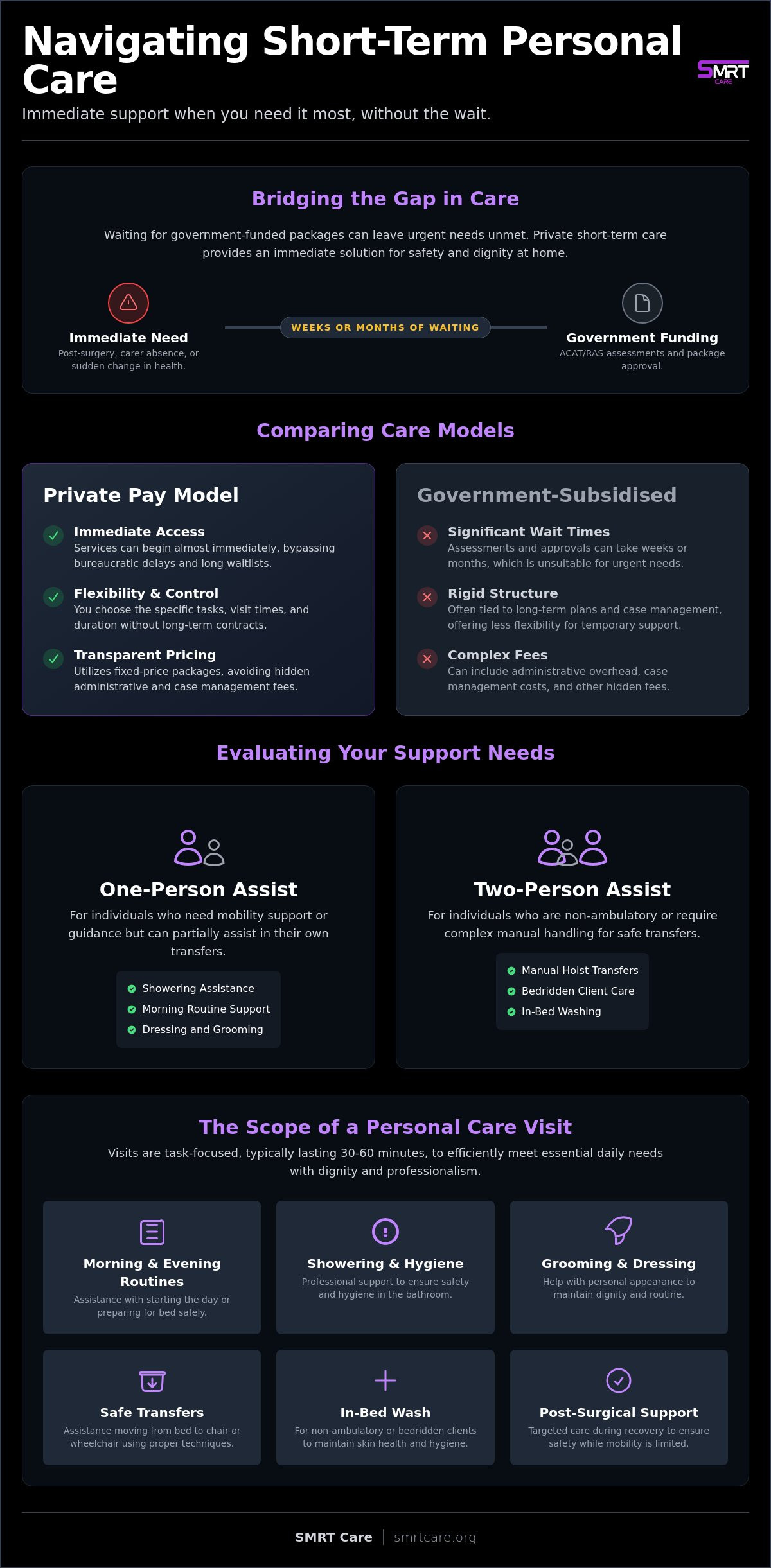
Short term personal care visits are scheduled, task-specific sessions designed to help individuals manage their Activities of Daily Living (ADLs). Unlike traditional long-term care contracts, these visits focus on immediate physical requirements during a set period. In Melbourne, this model provides a flexible alternative for those who don't require permanent residential care but need professional assistance to remain safe at home. To understand the broader context of these services, it's helpful to look at What is Home Care? and how it applies to temporary support structures.
A standard visit typically ranges from 30 to 60 minutes. This timeframe is dictated by the complexity of the assistance required. For instance, a Basic Care Visit might focus on fundamental hygiene, while Showering Assistance, a One Assist Visit, or a Two Assist Visit involving manual handling equipment may require more coordination. The goal is efficiency and dignity. By focusing on specific tasks, these visits ensure that essential needs are met without the unnecessary cost of a full-day care worker.
Situations Requiring Temporary Personal Support
Temporary support is often a pragmatic response to a sudden change in physical capability. Post-surgical recovery is a common trigger. When mobility is limited following a procedure, a professional carer can manage transfers and hygiene until the individual regains independence. These visits also serve as a critical bridge for those waiting on government funding. Since the Support at Home program replaced Home Care Packages on November 1, 2025, administrative processing times can still leave families in a lurch. Professional short term personal care visits fill this gap immediately. Additionally, these services provide essential relief when a primary family carer is temporarily absent or needs a structured break from daily physical demands.
The Scope of a Personal Care Visit
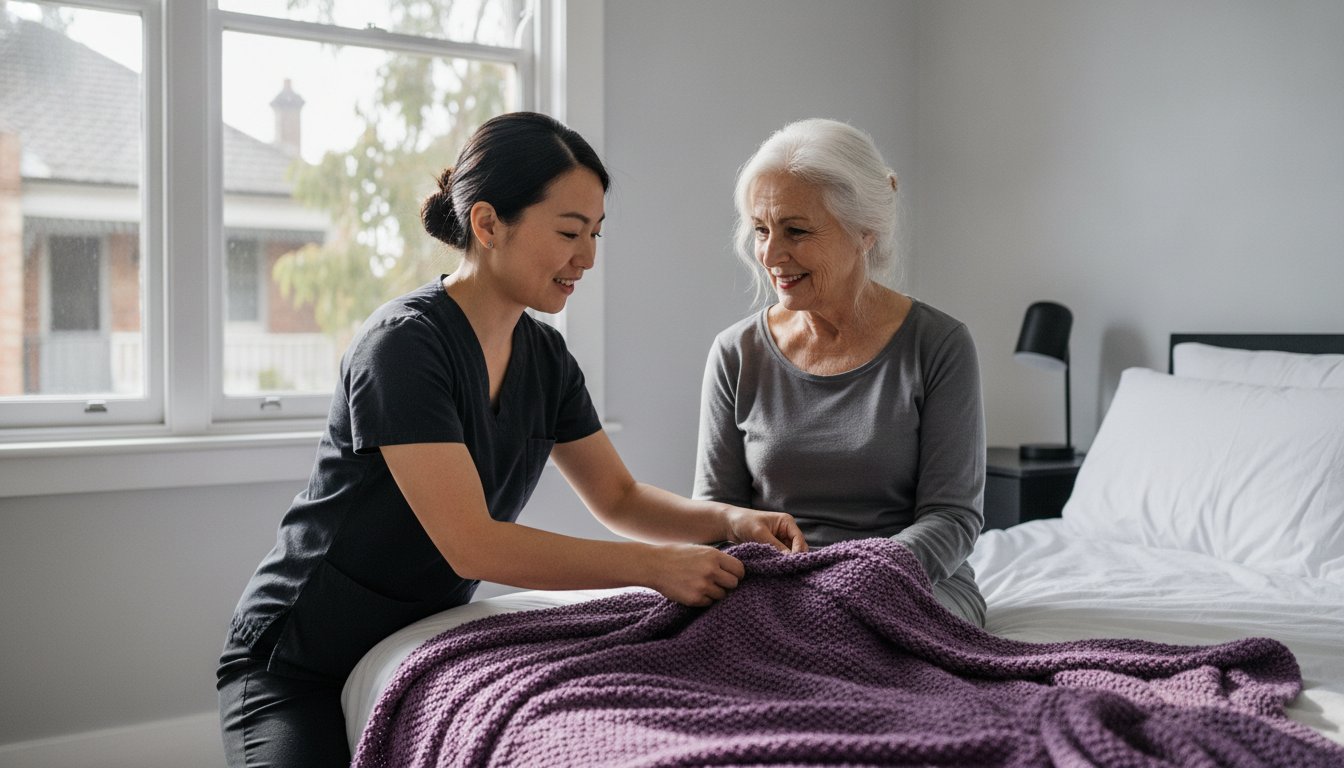
The scope of a visit is defined by the specific physical needs of the client. It isn't about general domestic help; it's about essential bodily care. This includes professional assistance with grooming, dressing, and Showering Assistance. For clients who are non-ambulatory or bedridden, an In-bed Wash ensures that hygiene standards are maintained with professional precision. Morning routine support is particularly vital. It ensures a safe start to the day by assisting with the transition from bed to chair, helping with dressing, and ensuring stability during initial movements. This task-based approach prioritizes the individual's dignity while maintaining a clear focus on safety and stability.
Comparing Care Models: Private Pay vs. Government Subsidised
Choosing between government-subsidised care and private pay models is a decision usually driven by urgency. Government programs, including the Support at Home program, provide essential financial relief for long-term needs. However, accessing these funds requires assessments by the Aged Care Assessment Team (ACAT) or Regional Assessment Service (RAS). These evaluations often involve wait times that stretch into weeks or months. For families requiring immediate short term personal care visits, these administrative delays are often not an option. Private pay models allow for service commencement almost immediately, bypassing the bureaucratic queue entirely.
The choice of model also impacts the level of control you have over the service. Private care allows for a task-based approach where you define the frequency and type of visit. Whether you need a Basic Care Visit or specialized Showering Assistance, the focus remains on the immediate physical requirement rather than long-term case management.
Speed of Access and Flexibility
The primary advantage of the private pay model is its responsiveness. When a person is discharged from a hospital or a family carer becomes unavailable, hygiene and safety needs are immediate. Private visits offer the flexibility to book short-term blocks without long-term contractual commitments. This is particularly useful in Melbourne, where private personal care attendants can be deployed quickly to address urgent gaps. When evaluating your support needs, consider the timeline of your recovery. If you expect to regain independence within a month, the effort of a government assessment may outweigh the benefits of the subsidy.
- Immediate start dates for urgent hygiene needs.
- No requirement for complex government assessments.
- Ability to scale visits up or down as recovery progresses.
- Freedom from long-term contracts or exit fees.
Transparency in Care Costs
Financial clarity is often easier to achieve with private models. Subsidised packages frequently involve income-tested care fees and asset assessments that create ongoing administrative complexity. Many providers also charge "care management" or "administration" fees that can consume a significant portion of a government package's value. Private, fixed-price packages eliminate this uncertainty. You pay for the specific service performed, such as a One Assist Visit or a Two Assist Visit, without hidden overheads. This transparency is essential for families managing a strict budget during a recovery period. If you need a clear understanding of your outgoings, you can view task-based pricing options to see how they fit your financial plan.
Recovery isn't always linear. Private pay models allow you to adjust your support level instantly. You might start with a Two Assist Visit for safe transfers and transition to a One Assist Visit as mobility improves. Unlike government packages, which often require a formal reassessment to change funding levels, private services adapt to your physical state in real-time. This ensures you only pay for the level of assistance you currently require, maintaining both your budget and your dignity.
Evaluating Your Support Needs: 1-Person vs. 2-Person Assistance
Determining the level of physical assistance required is a clinical decision, not a matter of convenience. When arranging short term personal care visits, you must distinguish between a One Assist and a Two Assist requirement. This distinction ensures both the safety of the individual and the professional carer. While government-funded aged care services often provide broad support, specific task-based visits require a clear assessment of mobility to be effective.
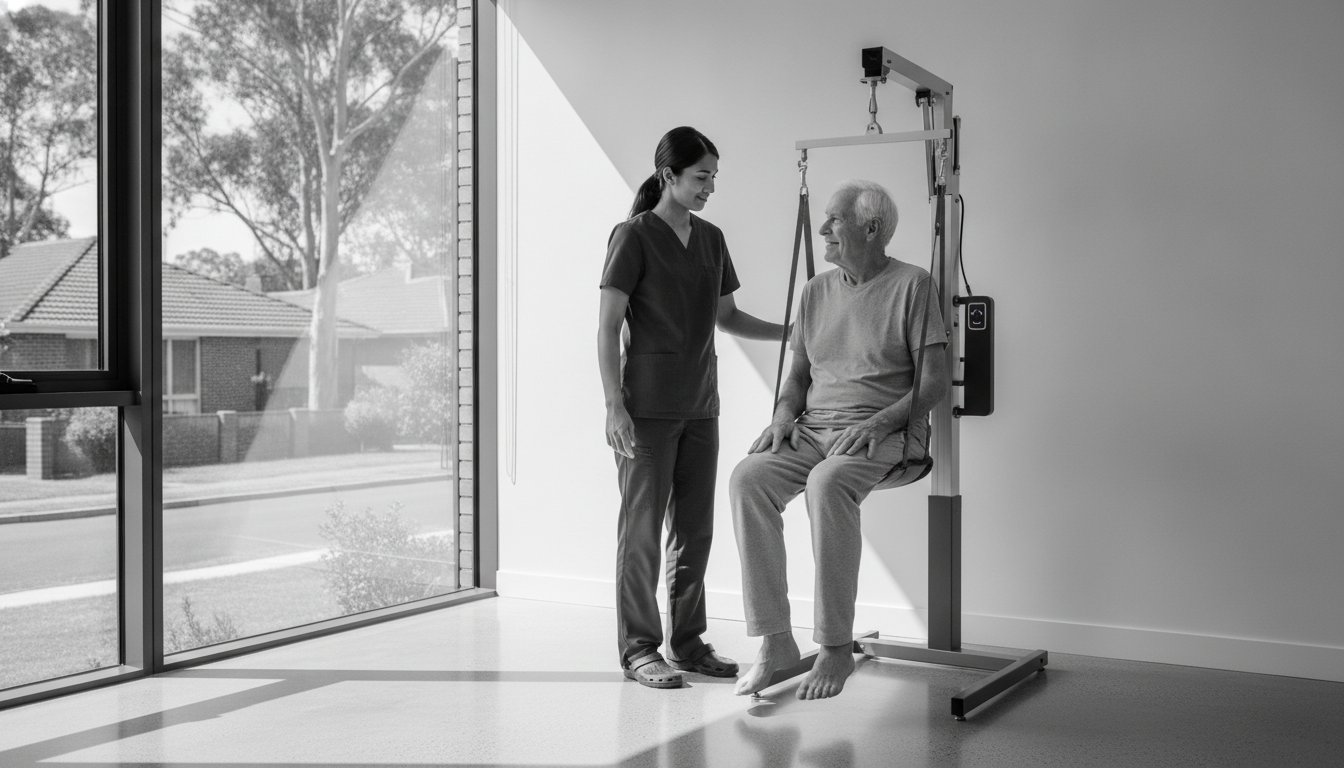
A One Assist Visit is appropriate for clients who can bear some weight but struggle with balance or fine motor skills. This level of support is common for tasks like Showering Assistance or dressing. In contrast, a Two Assist Visit is a mandatory safety requirement for non-weight-bearing individuals. It involves the use of manual handling equipment such as floor or ceiling hoists. Melbourne safety standards are clear: mechanical lifting requires two trained attendants to mitigate the risk of falls or injury.
Manual handling is not a test of strength. It is a disciplined application of technique. Even if a family member feels they can lift a loved one, professional standards require specific protocols to protect the client's joints and skin. A Two Assist Visit ensures that one person manages the equipment while the other ensures the client is positioned correctly within the sling. This reduces the risk of skin tears or muscle strain during the transition.
When is a Two-Person Assist Mandatory?
Mechanical lifts are the primary indicator for a two-person team. This is essential for clients who cannot assist with their own transfers or who require bariatric equipment. Safety is the priority. High-risk fall profiles also necessitate this level of support to ensure stability during transitions. All mechanical lifting procedures must be performed by two attendants to maintain the stability of the hoist and the safety of the client at all times.
Equipment-Specific Support: Sara Stedy and Slide Sheets
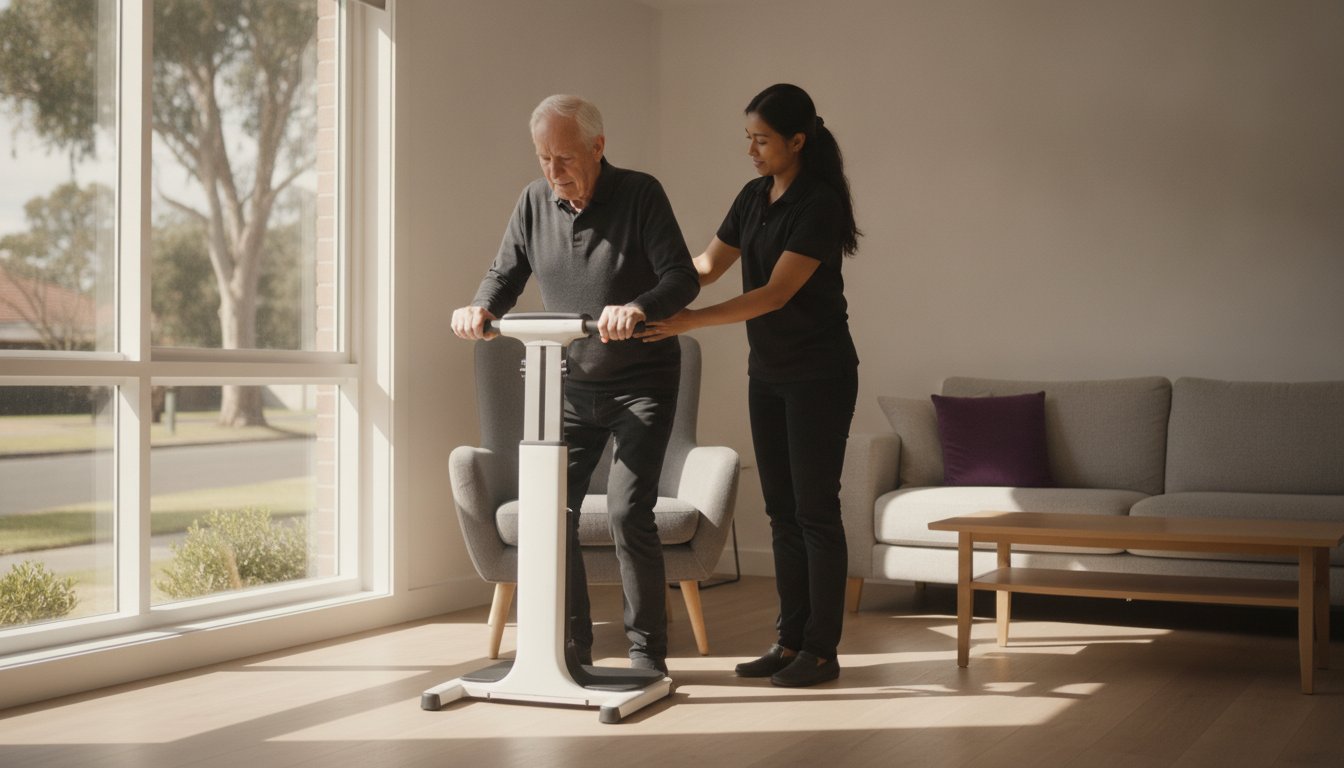
Professional support often utilizes specialized aids to maintain dignity and safety. A One Assist Visit may involve active transfer aids like the Sara Stedy, which helps weight-bearing clients move between seated positions. For those requiring a Basic Care Visit or an In-bed Wash, slide sheets are used to reposition the client without causing skin shear. These tools require clinical precision to prevent pressure areas. To understand the technical requirements of these tools, read our Manual Handling Personal Care Support: A Pragmatic Guide for Melbourne Families.
Mobility levels can change daily during recovery. You might start with a Two Assist Visit and move to a One Assist Visit as physical strength returns. This task-based approach ensures that the support matches the physical state of the individual exactly. There is no ambiguity. We define the assistance based on the physical reality of the transfer, ensuring a safe and predictable environment for everyone involved.
Planning the Logistics of Temporary Care Visits
Effective short term personal care visits require more than just a booking. Success depends on logistical preparation. By structuring the home environment and the schedule, you ensure that every minute of the visit is focused on care rather than administration. This methodical approach reduces stress for both the client and the family. It's about creating a predictable environment where the focus remains on dignity and safety.
Start by identifying high-need periods. Most families find that morning hygiene routines or evening transitions to bed are the most challenging times. Scheduling visits during these windows provides the maximum impact. Next, perform a physical audit of the home. Ensure there are clear paths for mobility aids, walkers, or hoists. If you're using a Two Assist Visit, the environment must accommodate two attendants and the necessary manual handling equipment without obstruction.
Clear communication is the third step. Document specific preferences regarding hygiene products, water temperature, and the sequence of the routine. This ensures the Showering Assistance or Basic Care Visit is conducted exactly as preferred. Finally, prioritize a consistent schedule. While the support is temporary, a predictable routine allows the client to anticipate the visit, which builds trust and cooperation during the recovery period.
Consistency and Routine for Seniors
A regular schedule provides significant psychological benefits. For seniors recovering from illness, having a familiar personal care attendant reduces the mental load of the recovery process. This predictability is especially vital for clients with cognitive impairments or neurological conditions. Routine visits create a sense of security and reduce anxiety during a vulnerable time. To learn more about the specific structure of these sessions, read our guide on What to Expect from a Basic Care Visit for Seniors in Melbourne.
Preparing the Home for Professional Care
Preparation ensures the attendant can begin work immediately upon arrival. For an In-bed Wash or Showering Assistance session, have the following supplies ready:
- Clean towels and face cloths.
- Preferred soaps, lotions, and hygiene products.
- A fresh set of clothes laid out in the order of dressing.
- Continence aids if required.
If your care plan involves a One Assist Visit or Two Assist Visit, verify that all mechanical aids are serviced and in good working order. Batteries for hoists should be fully charged. Additionally, keep a clear folder in a central location containing medication lists and emergency contact details. This documentation is a safety requirement for any visiting attendant. If you're ready to organize your home support, you can book a structured personal care visit to start your recovery with professional assistance.
SMRT Care: Transparent Fixed-Price Personal Care Packages
SMRT Care provides a functional alternative to the traditional care model. We recognize that families seeking short term personal care visits often face a lack of clarity regarding costs. In many cases, providers hide pricing behind "call for a quote" barriers or non-binding budget estimators. We operate differently. Our service is built on tiered, fixed-price packages that eliminate the complexity of hourly billing and administrative overhead. You pay for the specific task completed, ensuring that your budget is directed toward actual support rather than corporate management fees.
Our service model is designed for immediate impact. We offer structured sessions that address the physical realities of daily living without the need for long-term contracts. Whether you require a single Basic Care Visit or a recurring schedule of Showering Assistance, our pricing remains transparent and predictable. This approach allows Melbourne families to plan their recovery with financial certainty, focusing on physical progress rather than invoice discrepancies.
Why Fixed-Price Models Benefit Melbourne Families
Predictability is the primary benefit of the SMRT Care model. When managing private-pay care, families need to know their exact weekly outgoings. Traditional care agencies often apply "travel fees," "weekend surcharges," or "after-hours loading" that make budgeting impossible. Our fixed-price structure removes these variables. We prioritize a pragmatic approach: the focus is on the successful completion of the task, not just the time spent on the clock. This ensures that the care attendant is incentivized to provide thorough, dignified support without rushing or extending the visit unnecessarily.
- No hidden administration or "care management" fees.
- Elimination of travel surcharges within our service areas.
- Clear, task-based pricing for One Assist Visit and Two Assist Visit options.
- Simplified invoicing that is easy for families and executors to track.
Our Commitment to Dignity and Safety
Dignity is a fundamental necessity, not a luxury. Our Melbourne-based team consists of trained personal care attendants who specialize in manual handling and Activities of Daily Living (ADLs). We maintain high training standards to ensure that every In-bed Wash or transfer is conducted with clinical precision. This specialization allows us to maintain the independence of our clients while ensuring their safety within the home environment. We understand that physical support is an intimate service; therefore, we prioritize professional boundaries and respectful communication at every stage.
Getting started with SMRT Care is a straightforward process. We have eliminated the long waitlists and bureaucratic hurdles common in the industry. If you require short term personal care visits to bridge a gap in funding or to support a post-hospital recovery, we can deploy our team quickly. We focus on the essential requirements of stability, hygiene, and safety. This disciplined approach ensures that your home remains a place of recovery and dignity. To secure professional support for your specific needs, you can browse our available packages and book a visit that aligns with your schedule and physical requirements.
Securing Reliable Support for Your Recovery Routine
Navigating temporary physical limitations requires a focus on practical solutions and clear safety standards. You now understand that task-based support provides immediate assistance while bypassing the administrative delays of government funding. By accurately identifying your assist requirements and preparing your home logistics, you ensure a safer and more predictable recovery environment. Short term personal care visits should be defined by the quality of the task rather than the time on the clock.
As a Melbourne-owned and operated provider, we prioritize the dignity of every individual through disciplined manual handling and equipment transfers. Our fixed-price tiered packages ensure you maintain financial control without the risk of hidden surcharges or administrative fees. We specialize in the essential requirements of mobility and hygiene, providing a reliable partnership during your recovery period.
Professional support is an essential foundation for regaining your independence at home. We are here to provide the structured assistance necessary to move forward with confidence. View our transparent personal care packages and book a visit to secure the professional support you need today.
Frequently Asked Questions
What is the minimum duration for a short term personal care visit?
Most short term personal care visits range from 30 to 60 minutes. The specific duration depends on the complexity of the physical assistance required. For example, a Basic Care Visit focusing on fundamental hygiene is typically shorter than a Two Assist Visit involving mechanical hoists. We prioritize task completion and safety over arbitrary time blocks.
Can I book a personal care visit for a single day in Melbourne?
Yes, you can book a single visit without the burden of a long-term contract. This flexibility is a primary feature of the private pay model. It's an ideal solution for families in Melbourne who need immediate hygiene support while waiting for government package approvals or when a primary family carer is temporarily unavailable.
Does short term care include help with manual handling equipment like hoists?
Yes, our team provides specialized assistance for clients requiring manual handling equipment. A Two Assist Visit is a mandatory safety requirement whenever floor or ceiling hoists are used. This ensures that one attendant manages the equipment while the second ensures the client remains stable and correctly positioned within the sling.
How is private-pay personal care different from a government home care package?
Private-pay care offers immediate commencement, bypassing the national waitlist for the Support at Home program. While government packages involve income-tested fees and complex administrative assessments, private short term personal care visits use a transparent, fixed-price model. This allows for instant scaling of support based on your actual recovery progress.
Is a two-person assist always required for bedridden clients?
A two-person assist is only mandatory if the client is non-weight-bearing or requires mechanical lifting. For bedridden clients who can assist with rolling or repositioning, a One Assist Visit or a Basic Care Visit may be sufficient. We determine the assist level based on the physical reality of the transfer and the safety of the environment.
Can I get help with a dignified in-bed wash if I cannot get to the shower?
Yes, we provide a specific In-bed Wash service for clients with restricted mobility. This session focuses on professional hygiene and skin integrity while the client remains in bed. It's a dignified alternative to showering that ensures essential grooming and hygiene needs are met without the risks associated with difficult bathroom transfers.
What happens if my care needs change from one-assist to two-assist?
You can adjust your service package instantly as your physical requirements evolve. Unlike government-funded models that require formal reassessments to change support levels, private models allow for immediate transitions. If your mobility decreases or you introduce new manual handling equipment, we simply switch your schedule to a Two Assist Visit to maintain safety.
Are there hidden fees for travel or administration with SMRT Care visits?
No, SMRT Care uses a fixed-price tiered package model that eliminates hidden costs. There are no separate travel surcharges or ongoing administration fees common in traditional care contracts. You pay the stated price for the specific short term personal care visits you book, ensuring complete financial transparency for your family.